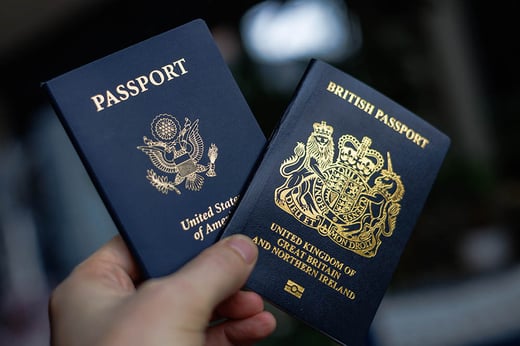
Every year, thousands of people living in the UK learn that they are considered US citizens for tax purposes, despite having spent most or all their lives in the UK.
At Experts for Expats we receive hundreds of enquiries each year from people who’ve recently suspected or discovered that they may need to file US tax returns, and we understand how daunting it can feel.
Most of the people we help haven’t ever lived or worked in the United States.
The good news is that pretty much all the accidental Americans we assist become compliant without facing penalties but understanding how US and UK tax systems interact is important.
This guide explains what accidental Americans in the UK need to know, the issues that commonly affect UK residents and the steps you may need to take to get compliant.
Disclaimer
This article is intended as general guidance only and should not be relied upon as tax or legal advice. US tax obligations depend on your individual circumstances, including your citizenship status, income, assets and financial arrangements. If you think you may be a US citizen or have US tax filing obligations, you should seek advice from a qualified US tax specialist before making any decisions.
Who is this article for?
This article has been written for people living in the UK who meet any of the following criteria:
- Born in the US but moved to the UK as a child
- Born in the UK to an American parent
- Applying for or renewing a US passport
- Contacted by either HMRC or IRS asking questions about a potential US connection
- Have inherited assets or received a gift from a US citizen
- Married a US citizen
Not all these scenarios mean that you’re an accidental American, however, it’s worth understanding the potential impact to decide whether it’s worth investigating more thoroughly to avoid potential penalties.
How do people find out they’re an accidental American?
For people living in the UK, some of the most common triggers include:
A UK bank, financial institution or mortgage lender asks whether you're a US citizen
The most common way people find out is when a UK bank or financial institution asks to confirm your citizenship, complete a tax residency declaration or provide a US Taxpayer Identification Number (TIN). This is because the institutions are required to identify customers who may have US tax obligations under the Foreign Account Tax Compliance Act (FATCA).
You're aware you may have US citizenship but weren’t aware there was a tax obligation
It’s quite common for people to be aware of a US connection, either through birth or their parents being US citizens and have researched about whether this makes them a US citizen. During that research, they discover that being a US citizen means they have a tax obligation.
You ask AI or search online
Increasingly, people discover they may be an accidental American after describing their circumstances to an AI assistant or searching online. A simple question such as "I was born in America but have lived in the UK all my life. Do I need to pay US tax?" can uncover filing obligations they were completely unaware of.
A family event raises questions
The death of a parent, applying for a first US passport, tracing family history or helping a relative with citizenship paperwork can all lead someone to discover that they may be a US citizen and have associated US tax obligations.
Why does living in the UK make things different?
People living in the UK will typically be established within the UK tax system, and may also have savings products and investment structures, many of which are designed to be tax-efficient for UK residents.
However, the US tax system does not always recognise these tax advantages. As a result, financial arrangements that are completely ordinary in the UK can require additional reporting to the IRS or have different tax treatment in the United States.
For example, if you're employed in the UK, your salary is likely to be taxed through PAYE and, in many cases, UK tax paid can help reduce or eliminate any additional US tax liability. However, filing obligations may still exist, even if no further tax is due.
Other financial products can be more complex. ISAs, Stocks & Shares ISAs, SIPPs, workplace pensions, Premium Bonds, UK investment funds, rental properties and limited companies may all need to be considered as part of your US tax position. Some simply require additional reporting, while others can create more complicated US tax issues depending on your circumstances and how they are structured.
If I am considered an accidental American, do I need to file US tax returns if I already pay tax in the UK?
Unlike most other countries, the United States taxes its citizens based on citizenship rather than where they live. This means that if you are a US citizen, you may still need to file annual US tax returns and other information reports, even if you have lived in the UK for decades and have no income from the United States.
The good news is that filing a US tax return does not necessarily mean paying US tax.
Many accidental Americans living in the UK ultimately owe little or no additional US tax because the UK already taxes much of the same income, often at similar or higher rates. The US tax system also includes mechanisms designed to reduce the risk of double taxation, including Foreign Tax Credits and the UK and US have a comprehensive double taxation treaty that helps determine which country has primary taxing rights in many situations.
However, these rules are not automatic, and they don't remove the obligation to file. In many cases, you need to submit a US tax return to claim the relevant reliefs or credits. Simply assuming your UK tax bill means there is nothing to report can lead to years of missed filing obligations.
As previously mentioned, not every type of income or investment is treated in the same way by both countries. UK tax-efficient products such as ISAs or certain investment funds may not receive the same treatment under US tax rules, which is one reason why becoming compliant can be more complex than many people initially expect.
How do I know if I'm behind with my US tax obligations?
Accidental Americans typically don't realise they have missed any filing obligations until years after they first became responsible for them, hence why they’re referred to as “accidental”.
If you've only recently discovered that you could be considered a US citizen for tax purposes, it's possible that you're behind, even if you've always paid the correct amount of UK tax.
If you’ve recently established that you’re an accidental American, you may need to catch up on your US tax filings if:
- You've never filed a US tax return, despite being a US citizen
- You've never submitted an FBAR (Foreign Bank Account Report), even though the total value of your non-US financial accounts exceeded the reporting threshold
- You have UK bank accounts, savings or investments that may need to be reported to the IRS
- You've only recently discovered that you are a US citizen or that US citizenship carries ongoing tax filing obligations
Being behind doesn't necessarily mean you've done anything wrong or that you'll owe a large amount of tax. The IRS recognises that this situation exists, which is why there are procedures that allow eligible taxpayers to become compliant, such as the Streamlined Filing Compliance Procedures.
What should I do if I think I might be an accidental American?
I think readers love chronological content.
- Step 1: Don't panic and don’t make any snap decisions
- Step 2: Confirm whether you're considered a US citizen by speaking to a US tax specialist
- Step 3: Understand what needs filing and learn about the Streamlining process
- Step 4: Gather UK documents such as:
- P60
- Self-Assessment tax returns
- Pension statements
- ISA statements
- Bank and savings statements
- National Insurance details
- Final step: Get and remain compliant
Common UK financial matters that create unexpected US tax issues
Some of the UK's most common financial situations and products don't receive the same tax treatment in the United States. This doesn't necessarily mean they create additional tax to pay, but they can result in extra reporting requirements or more complex US tax calculations. They may also limit who you can get advice from and the products you can open in future.
ISAs
Individual Savings Accounts (ISAs) are one of the most popular ways for UK residents to save and invest because income and gains are generally free from UK tax but the US does not automatically recognise the tax-free status of an ISA.
Depending on what is held within the account, income and investment gains may still need to be reported on your US tax return.
Workplace pensions and SIPPs
Most people working in the UK will have a workplace pension, while many self-employed individuals and higher earners also contribute to a Self-Invested Personal Pension (SIPP).
The US tax treatment of UK pensions can be complex and depends on factors such as the type of pension and the relevant provisions of the UK-US tax treaty. While many pensions do not create immediate US tax liabilities, they may still need to be reported, making specialist advice worthwhile.
UK investment funds
UK investment funds can be one of the most complicated areas of US tax compliance because funds that are perfectly ordinary investments in the UK are treated as Passive Foreign Investment Companies (PFICs) under US tax rules.
PFICs have their own reporting requirements and can be subject to complex tax calculations, which is why they are often one of the first areas a specialist will review.
Selling your UK home
If you sell your main home in the UK, you typically won’t pay Capital Gains Tax because of Private Residence Relief.
The US has different rules for taxing gains on the sale of a principal residence, so a sale that is tax-free in the UK does not automatically receive the same treatment in the US.
If you are planning to sell a property, it's sensible to understand the US position before the transaction takes place.
Running a UK limited company
In addition to reporting your income, there may be separate filing requirements relating to the company itself, and different rules can apply depending on how the business is structured.
If you own shares in, or control, a UK company, it's particularly important to seek advice from someone familiar with both UK and US tax systems.
Investing in the UK as an American
Financial advice is much harder to get once you realise you’re a US connected citizen. To help, we created a guide to the most common questions we get asked which you can read here: Investing in the UK as an American: the questions we get most frequently asked
When should I get professional advice?
If your finances are relatively straightforward, becoming compliant can be simple and it’s possible to do this yourself.
If you have no other income except employment income taxed through PAYE, no significant investments and no rental properties or business interests your situation is easier to assess. It’s still worth getting advice to ensure you get things right, but getting compliant will be straightforward.
If you have more complicated financial affairs, including a combination of the financial situations mentioned previously, you may have additional reporting obligations or require more detailed analysis.
A specialist who understands both UK and US tax rules can help ensure you're taking the correct approach and identify any planning opportunities before returns are submitted.
How much does it cost to get specialist help?
The cost of becoming US tax compliant varies depending on the complexity of your circumstances, the number of returns that need to be prepared and whether you qualify for the IRS Streamlined Filing Compliance Procedures.
As a broad guide, a relatively straightforward accidental American with employment income, standard UK bank accounts and no significant investments might expect professional fees to start from around £1,000 to £2,500.
More complex cases involving investment funds, business ownership, trusts or extensive investment portfolios can cost considerably more, particularly where specialist analysis or additional reporting is required.
While this may seem like a significant expense, it's worth remembering that becoming compliant is often a one-off exercise. Once historic filings have been brought up to date, future annual returns are usually much simpler and less expensive to prepare.
When comparing advisers, it's worth asking exactly what is included in their fees. Some firms quote only for preparing tax returns, while others include advice on your eligibility for the Streamlined Filing Compliance Procedures, reviews of UK investments and pensions, FBAR reporting, ongoing tax planning and support if the IRS requests further information.
Choosing an adviser with experience of both the UK and US tax systems can also save money in the long run. Understanding how UK pensions, ISAs, investment funds and other financial arrangements are treated under US tax rules is often just as important as completing the tax returns themselves.
Is it worth renouncing my US citizenship?
Becoming tax compliant is often the first step towards renouncing your US citizenship but retaining US citizenship can offer valuable benefits, such as the right to live and work in the United States or to pass citizenship on to future generations.
Factors such as your family connections, career plans, future retirement intentions, tax position and the value you place on US citizenship should all be considered before making a decision about whether to give up your US citizenship.
If you're considering this route, it's worth understanding both the legal and tax implications before taking any action. Read our guide to how to renounce your US citizenship for a detailed explanation of the process.
Related reading
Next steps to take
While it's understandable to feel worried, most situations are manageable once you understand your position. The key next step is to avoid making assumptions or delaying decision making.
Instead, take the time to establish whether you are a US citizen, understand which UK income, assets and financial products may need to be reported, and identify the most appropriate route to becoming compliant.
If you'd like to discuss your situation with a specialist in US tax for UK residents, we can introduce you to an experienced adviser from our network. They can assess your circumstances, explain your options, advise whether the IRS Streamlined Filing Compliance Procedures are likely to be appropriate, and help you become compliant with confidence.